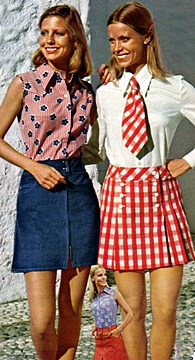
The Skirt/Shorts Helped Define a Generation’s Grievances and Aspirations
7/17/26 – -There’s been lots of interesting news this week, from oppressive heat domes and exciting World Cup soccer to escalating Middle East conflict and contentious Washington confirmation hearings. But according to yesterday’s New York Times, the topic of its most-clicked-on article was the resurging popularity of culottes.
Headlined “Culottes Are Cool Again,” the story so many people (including me) have been reading reports that updated styles of the combination skirt/shorts are flying off retail shelves.
Why so much interest in a quirky item of apparel that was last in-fashion 60 years ago?
Culottes Were a Badge of Rebellion for Baby Boomers
Thinking about culottes brought me (and I suspect thousands of other baby boomers) back to the turbulent 1960s, when social norms, including women’s fashion, were being challenged. Throughout the decade, hemlines worn by supermodels like Twiggy and Cybill Shepherd were rising, and liberating trends were being covered on the pages of editor Helen Gurley Brown’s Cosmopolitan magazine.
School and business dress codes, unchanged for decades, required girls to wear skirts of modest length. No shorts or slacks. Culottes, described in the Times article as “deceptive shorts that look like a skirt,” offered a loophole for rebellious students and young working women.
At least that was the hope in 1965 for the eighth-grade girls who along with me were attending Skokie Junior High School in Winnetka, Illinois.
Our principal, however, had a different point of view.
Essentially every girl was coming to school every day wearing culottes. Outraged by the disobedience, he laid down the law in a morning message broadcast over the PA system into homeroom classes: “Beginning tomorrow, any student coming to school wearing culottes will be sent home and suspended for one week.”
The next 24-hours were among the most stressful and instructive in my then 14 years on Earth.
My Introduction to Social Activism and Peaceful Protest
The girls immediately began organizing. Every eighth-grade girl pledged to come to school the next day defiantly dressed in culottes. There was to be no communication with parents or teachers. And there was a special request made of the eighth-grade boys: If the principal followed through on his threat, we would walk out (go home) in solidarity with our repressed sisters.
You can imagine the angst and dialogue that ensued after school at the Sweet Shop in town and over the phone throughout the evening (our form of social media). I don’t think I got much sleep that night, concerned that my participation would jeopardize my graduation and advancement into ninth grade at New Trier High School. And I didn’t look forward to explaining my delinquency to my parents, as righteous as it seemed to me.
As I left for school the next morning, I thought about saying “see you in a few minutes” to my mother. Driving my bike, I started planning what I would do at home for the week I was suspended. Would my parents allow me to watch television? Would my teachers send me homework assignments? Was this all worth it?
When I pulled up to the bike rack at school, there was already commotion. The girls were forming as a group to enter the front door together. The principal and several teachers were standing at the door, ready to inspect the girls and turn away violators.
While the moment didn’t come close to the seriousness of Governor George Wallace’s blocking black students’ entry into the University of Alabama two years earlier (our soft social activism was protesting a dress code, not challenging racial segregation) the tense scene is seared in my memory.
Witnessing the Power of the Press
As I stood with the girls, I noticed a strange man with a note pad talking with our visibly agitated principal. They had a heated conversation for about 10 minutes. Then the principal and teachers stepped inside and allowed the girls, wearing their culottes, to come in and go to their homeroom classes.
Moments later over the loudspeakers, the principal announced: “We will be forming a student-teacher committee to review our dress code. While they are completing their work, culottes consistent with the length standard for skirts will be permitted. Have a good day.”
Cheers erupted throughout the building.
The girls had stood their ground and won. The boys (including me) had dodged a bullet.
We learned who the man with the notepad was when the Winnetka Talk newspaper published his article reporting on the standoff in their next edition. In it were quotes attributed to the principal and statements by “female Skokie Jr. High students who do not wish to be identified.”
Turns out while many of us were in town at the Sweet Shop worried about the next morning’s drama, a few enterprising girls visited the offices across Elm Street of The Winnetka Talk. They found a receptive reporter and had the smarts to give him the background “not for attribution.”
I don’t remember if the article mentioned the promised support of the boys. But I do remember thinking, probably for the first time, about the importance of local news media to communities. No news coverage, no culottes.
So, culottes will always be a reminder for me of formative experiences and lessons that shaped my life and career. And I think for most baby boomers (many read The New York Times), the “deceptive shorts that look like a skirt” bring back memories of the social progress made during a turbulent, wonderful time in our lives.