
Unplugged Experiences for AI-Dependent Students Balance the Wonders of AI and Human Growth
8/27/25 – – As the new school year begins, teachers are turning to an old-school tool to limit the disruption of generative artificial intelligence. This inexpensive, carbon-based antidote to the cheating potential of ChatGPT, Gemini and other generative AI programs is the “blue book.”
Sequestered in class, smartphones off, students in high schools and colleges are once again being required to manually write essays and answer exam questions on paper. Educators are encouraging the use of AI for research and study. But they’re concerned that without unplugged assignments, cognitive development will suffer, and they’ll be grading papers authored by machines.
A Low-Tech “Write” of Passage
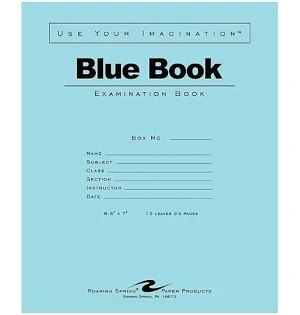
Generations of students spent stressful hours transferring their knowledge (as legibly as possible) onto lined paper stapled into blue covers. No notes, no internet, no spell check. Just you and the dreaded 8.5”x7” blue book.
I remember worrying about being able to fill in every page, both sides. There was no time to make revisions. But it sure felt like you’d accomplished something when you dropped your finished blue book on the teacher’s desk.
Use of blue books fell off during the pandemic. Remote learning made administering in-class, in-person tests impossible. Papers had to be typed and transmitted over the internet. While students could search online for answers at home, access to generative AI and its magical ability to summarize topics and craft near-flawless prose was still a few years away.
Printing Presses Are Humming Again
With generative AI programs now cheap and ubiquitous, the Roaring Spring Paper Products company is benefiting from a blue book renaissance. The family-owned printer has been operating for more than 100 years in the small Pennsylvania town of Roaring Spring, which according to The Wall Street Journal is, “the blue book capital of America.”
In a May 23, 2025, article headlined, “They Were Every Student’s Worst Nightmare. Now Blue Books Are Back,” the Journal reported that the company sells a “few million” blue books a year. Colleges and universities are stocking up:
“Sales of blue books this school year were up more than 30% at Texas A&M University and nearly 50% at the University of Florida. The improbable growth was even more impressive at the University of California, Berkeley. Over the past two academic years, blue-book sales at the Cal Student Store were up 80%.”
Preserving Human Capabilities
New York University Vice Provost Clay Shirky in a New York Times essay titled, “Students Hate Them. Universities Need Them. The Only Real Solution to A.I. Cheating Crisis,” explains what’s at stake:
“Learning is a change in long-term memory: that’s the biological correlation of what we do in the classroom. Now that most mental effort tied to writing is optional, we need new ways to require the work necessary for learning.”
There’s a broader, promising lesson in educators’ refusal to surrender to AI. In everything we do, it’s critical that while embracing the wonders of this evolving technology we keep developing the human capabilities of reasoning, expression and creativity.
It’s encouraging that something so simple as the blue book can help assure that balance.
Besides, why shouldn’t today’s and tomorrow’s students have to suffer like we did!
 Crisis Quotient Blog